When the State Watches the Watchers: Assembly Rights and the 2026 Protest Policing Bill
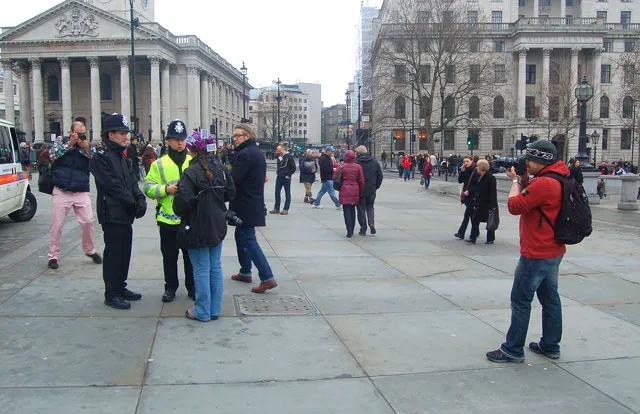
Photo: Andy F , CC BY-SA 2.0, via Wikimedia Commons
Britain has a habit of praising protest in the abstract while tightening the rules in practice. The Oxford Amnesty Lectures archive is useful precisely because it refuses that habit. Its lectures on assembly, dissent and state power form a record of arguments made in public, by people who understood that human rights are not won by sentiment alone. As the 2026 protest policing bill returns to the centre of debate, that archive offers something more than historical comfort. It offers a rights test.
The archive as a warning system
The Amnesty lecture tradition has never treated the right to protest as a decorative extra in a healthy democracy. Again and again, its speakers have returned to a set of uncomfortable questions: when may the state restrict assembly; who decides what counts as disorder; and how can policing remain accountable when it is given new powers. The answers in the archive are not uniform, but the method is consistent. Restrictions on rights must be lawful, necessary and proportionate. Policing by consent depends on public confidence, not merely on legal authority. And criminal law should not be used to manage political inconvenience.
Those arguments anticipate today's debate with uncomfortable precision. The 2026 bill is presented as a measured response to disruptive tactics. Its supporters speak of balance. But the archive teaches that balance is not a neutral word. It asks who bears the cost of restriction, and whether the least restrictive option has been tried. A demonstration that inconveniences a city is not the same as a demonstration that threatens public safety. A protest that is noisy, slow or unpopular is still protected by Articles 10 and 11 of the European Convention on Human Rights, given effect in UK law by the Human Rights Act 1998.
What the 2026 proposals get wrong
The human-rights red flags in the current proposals are not mysterious. They concern legal certainty, pre-emptive control and the machinery of enforcement.
First, vague thresholds. Terms such as serious disruption, intimidation or nuisance can be stretched to cover ordinary campaigning. Human-rights law requires restrictions to be prescribed by law with sufficient precision. A protest should not depend on an officer's mood or a council's aversion to inconvenience.
Second, pre-emptive conditions and bans. Powers to impose conditions before an event, or to restrict assembly in anticipation of disorder, risk punishing people for what they might do rather than what they have done. The archive's lectures on state power have long warned that preventive logic can become a permission regime for public space.
Third, expanded stop and search, equipment seizure and arrest powers. These are not abstract authorities. They are experienced as humiliation, delay and fear. If they are used disproportionately against young people, racialised communities, climate activists or Palestine solidarity campaigners, the chilling effect is not incidental. It is the point.
Fourth, surveillance. Facial recognition, data retention and intelligence-sharing can turn protest into a data-harvesting exercise. The right to assemble includes the right not to be tracked for exercising it.
Fifth, unequal impact. Restrictions rarely fall evenly. They fall on those with less legal advice, less time and less confidence in the police. A bill that is neutral on its face can deepen inequality in who gets to speak.
Reading the record: documenting excessive policing
Documentation is not a substitute for political argument, but it is part of accountability. The archive's emphasis on testimony is a practical instruction. At protests, the record must be made carefully.
Before an event, know the legal basis for conditions, carry a charged phone, agree a buddy system and note the numbers of legal observers. Legal observer groups and organisations such as Liberty, Netpol and Green and Black Cross publish practical guidance. A solicitor's number should be written down, not only stored on a phone that may be seized.
During an event, record the time, location, officer identifiers, unit markings and exact words used. Film continuously where it is safe to do so, narrate the date and place, and avoid obstructing police. Note conditions as they are announced, not as they are remembered. Record arrests, use of force, injuries, equipment damage and the names of witnesses. If someone is told to move, ask under what power. If a section 60 order is claimed, note the time and wording.
After an event, write an incident log within twenty-four hours. Preserve original files and metadata. Seek medical evidence where needed. Collect witness statements while memories are fresh. Complaints should go to the force's professional standards department and, where serious, to the Independent Office for Police Conduct. Documentation only becomes accountability when it is organised, corroborated and pursued.
From testimony to accountability
The deeper lesson of the Oxford Amnesty Lectures archive is that testimony becomes power when it is shared. A single account of excessive policing can be dismissed. A patterned record is harder to ignore.
That is why the 2026 bill should be read not only by lawyers but by campaigners, students, faith groups and local councillors. The right to protest is not a privilege for the likeable. It is a democratic safeguard for everyone. The archive does not tell us exactly what the courts will decide. It does tell us what questions must be asked, and what records must be kept. In that sense, the right to roam the record is also the right to hold power to account.